Showing posts with label NWO. Show all posts

Tuesday, November 23, 2010

STEPHEN GLOVER: WOULD IT BE SO BAD IF THE EURO FAILED?

Even as Ireland is rescued by the European Union and the International Monetary Fund to the tune of £70billion, economists and market makers are warning that the euro crisis is far from over. Indeed, it could be just beginning.

Portugal is the next indebted eurozone economy which the markets believe is vulnerable, and may have to be bailed out as Ireland and Greece have been. Spain could then be targeted. Its economy is roughly seven times larger than Ireland’s.

Rescuing a country as big as Spain would put enormous pressure on the EU’s bailout fund. It would entail the European Central Bank taking on the country’s debt, which would dramatically undermine the markets’ confidence in the euro.

Against the euro: Margaret Thatcher and Gordon Brown. They understood the single currency's flaws

Against the euro: Margaret Thatcher and Gordon Brown. They understood the single currency's flaws

No one can say what would then happen. The euro might just conceivably collapse, though the German and French governments will fight very hard to save it because it is the centrepiece of the project for a united Europe. A more likely outcome might be a two-tier euro in which weaker economies such as Portugal, Greece, Spain and Ireland were allowed to devalue their currencies. That would entail the end of the euro as we know it.

What do such seismic shocks mean for Britain? It would obviously not be in our short-term interests for the euro to go under in a way that created economic mayhem in the 16 eurozone countries, which account for a large proportion of our trade. That has been the Coalition’s justification for providing some £10billion to Ireland in loans and guarantees as part of the bailout, since the country, though small, is one of our largest trading partners.

A bankrupt Spanish government could have repercussions even on the British high street. Spanish-owned Santander, which has ambitions to be Britain’s biggest bank, is thought to be sound. But it could hardly remain unaffected were the Spanish economy to collapse.

As further upheavals and more bailouts loom, we should be asking ourselves some fundamental questions. Is it in the interests of the United Kingdom to be spending billions of pounds shoring up a failing currency? Is it to the benefit of ‘basket cases’ such as Greece and Ireland to be rescued in this way? And is the long-term survival of the euro in the interests of this country?

The euro, never forget, is first and foremost a political project. Its architects believed that Europe could be bound together in a fledgling superstate only if its countries ceded economic sovereignty and adopted a common currency.

Here is the moment to doff our caps at the two leaders who understood the essentially political nature of the project as well as its economic flaws. It was above all Margaret Thatcher’s suspicions of what was then the European Community, as well as of the proposal for a single currency, which led to her downfall. And, although it pains me to say so, Gordon Brown was responsible as Chancellor for keeping us out of the euro when Tony Blair was an enthusiastic advocate for joining it.

The euro is defective because it seeks to bind together disparate countries which run their economies in very different ways. Germany, at one extreme, is generally a tight ship. Greece, at the other, has been spending money on a scale it could not afford. In good economic times, the differences could just about be accommodated but the tensions became unsustainable when the Great Recession hit.

Ireland, Greece and Portugal have significantly lost competitiveness against the eurozone’s strongest member, Germany, since the launch of the single currency. Without the ability to devalue their currency, they will be unable to stage an economic recovery.

The EU rescue countries are like doctors pressing drugs on a patient when the only real cure is an entirely new lifestyle. A single currency for a group of countries that can run up huge deficits is a flawed concept. If it is difficult now to see how the euro can survive in its present form, it will be impossible when – or if – Spain is taken into intensive care, not inconceivably followed by Italy. Although undoubtedly a cause for concern in the short term, the euro’s tribulations should be a cause for some rejoicing in the longer term.

If the euro is the engine for European integration, it follows, if the engine misfires and threatens to go dead, that those who believe in the sovereign nation state should be relieved. The lesson of the past 20 years is that the European elites, Britain’s included, have high-handedly committed their peoples to ever greater integration.

The Labour government broke its promise to call a referendum on the Lisbon Treaty, which would have almost certainly been rejected.

The juggernaut rolls on even under this government, led by a supposedly Eurosceptic Prime Minister who has recently declared that he will not call a referendum on another European treaty, on the questionable grounds that it will not affect this country because we are not part of the eurozone.

In other words, the possible demise, or at least the radical curtailment, of the euro project is the only realistic means by which the European superstate can be stopped in its tracks. That is why I was so surprised to hear the Chancellor, George Osborne – allegedly a Eurosceptic – say on the BBC yesterday that ‘we have got to make the single currency work’. Why, if its successful operation would strengthen the movement towards European integration?

The balance of probabilities is that the euro cannot be made to work in its existing form, but do not underestimate the determination of those who will defend it in the last ditch. The new treaty, which Mr Cameron says he will rubber-stamp, is intended to increase the powers of the European Central Bank and the European Commission over ‘miscreant’ countries such as Greece, Ireland and Portugal. What has just been done to Ireland – the country has been stripped of its economic self-determination – may be a foretaste of what is to come.

The euro crisis should provide the British government with an excuse to put a check on the European project, and present its vision of Europe as a loose coalition of friendly sovereign states trading with one another. Instead, we see – through its loan to Ireland and Mr Osborne’s disarmingly pro-euro rhetoric – the Government propping up the very thing that most threatens what remains of British sovereignty.

No one should be fooled by the Chancellor’s assertion that the loan to Ireland is ‘bilateral’ and thus has nothing to do with Britain’s obligations under an EU bailout agreement.

Mr Osborne was less than robust in suggesting that Britain will try to exempt itself from this ‘stability mechanism’ to which Alastair Darling foolishly signed up when he was Chancellor.

As things stand, if Portugal and Spain go down, hard-pressed Britain will have no option but to lend them billions of pounds – and again shore up a failing currency – whether it wants to or not.

The euro is not good for many of its members. It is the motor of European integration. Why, then, does this government, supposedly led by Eurosceptic Tories rather than Europhile Lib Dems, regard the difficulties of the single currency as merely a crisis – and not also as an opportunity?

WHO WILL WE HAVE TO BAIL OUT NEXT? BRITAIN PAYS OUT BILLIONS AS IRELAND IMPLODES

By James Chapman 23rd November 2010

  • Irish PM refuses to stand down but WILL call New Year election
  • George Osborne faces dissent from his own back benches
  • Euro sinks as bailout fails to ease fears about the debt contagion
  • Banking shares crash as Irish coalition government implodes
  • Demonstrators take to the streets of Dublin and clash with police

Britain is in danger of being sucked into yet more multi-billion-pound EU rescue packages as the Irish bailout threatens to spiral out of control.

Under the terms of a deal signed by Alistair Darling after Labour lost the May election, the UK can be required to offer guarantees to other EU countries until 2013.

So if the chaos continues to spread through Europe, we could have to bankroll other ‘basket-case’ economies such as Portugal and even Spain.

Scroll down for our video report

Defiant: Irish Taoiseach Brian Cowen, with Finance Minster Brian Lenihan (right), giving a statement on the steps of Government Buildings last night

Defiant: Irish Taoiseach Brian Cowen, with Finance Minster Brian Lenihan (right), giving a statement on the steps of Government Buildings last night

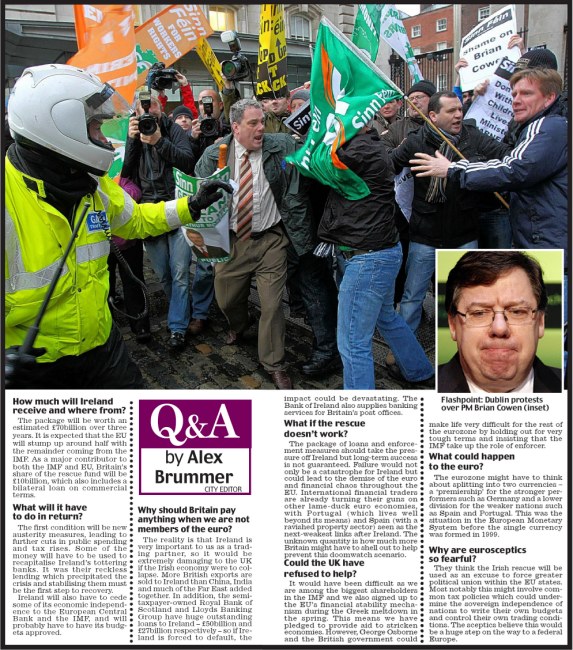
Confrontation: An Irish policeman confronts protesters as they break through the front gates of the Irish Prime Ministers office in Dublin today

Confrontation: An Irish policeman confronts protesters as they break through the front gates of the Irish Prime Minister's office in Dublin yesterday

Experts warned that the joint European and International Monetary Fund bailout package might have to be postponed, threatening the stability of the entire eurozone, after a snap general election was called in Ireland.

Prime Minister Brian Cowen, who at one stage had appeared on the brink of quitting, was instead forced to announce a poll early next year after his Green Party coalition partners effectively pulled the plug on the government.

The Taoiseach now faces the nightmarish task of trying to push through the country’s most controversial austerity package for a generation as a ‘lame-duck’ leader.

In Dublin, police had to eject a number of protesters, some from Sinn Féin, who forced their way into government buildings.

In Westminster, Mr Osborne told MPs it was ‘overwhelmingly in Britain’s national interest’ to support a major trading partner with which it had an ‘interconnected’ banking system.

‘Ireland is a friend in need and we are here to help,’ the Chancellor declared.

A Irish Army Military police officer confronts Sinn Fein protesters who broke through the gates at government buildings in Dublin today

An Irish Army military police officer confronts Sinn Fein protesters who broke through the gates at government buildings in Dublin yesterday

'TOXIC COCKTAIL' SENDS BANKS AND EURO PLUNGING

Shares in London tumbled and the euro sank as the Irish bailout failed to calm fears about the debt crisis tearing through Europe.

More than £13.3billion was wiped off the value of Britain’s biggest companies yesterday, with banks leading the sell-off.

The single currency also slid against the pound and the dollar on another rollercoaster day on the financial markets. Investors began the day in bullish mood after the Irish government finally caved in to EU pressure and admitted it needed a humiliating Greek-style bailout.

But gloom descended amid political turmoil in Dublin, worries about the health of Britain’s banks, and fears that Portugal and even Spain could also require a bailout. City commentator David Buik, of the spread-betting firm BGC Partners, described it as ‘a very toxic cocktail’ for the markets.

The FTSE 100 index of blue chip stocks fell 52 points to 5680.83.

Part-nationalised Royal Bank of Scotland and Lloyds Banking Group were the biggest fallers in yet another blow to British taxpayers. RBS dropped nearly five per cent to 39.84p while Halifax owner Lloyds was down more than four per cent to 63.93p.

This knocked £3billion off the value of the two banks, both of which have been propped up by the state and have a total of £80billion of loans tied up in Ireland.

British taxpayers are now sitting on losses of £6.8billion on their 84 per cent stake in RBS and 41 per cent holding in Lloyds. Will Hedden, a trader at City spread-betting firm IG Index, said: ‘The welcome news about the Irish bailout well and truly subsided into worries over UK banks’ exposure to the problem. Part-nationalised banks Lloyds and RBS are the big casualties.

‘Worries over stability in the Emerald Isle are being compounded as the bailout becomes more and more political by the day. The risk of contagion still lingers over European markets, with traders now eyeing up the next sacrificial lamb.’

He said the Irish deal should not set a precedent, but officials revealed that Britain could be forced to prop up other stuttering economies under the deal signed by Alistair Darling two days before the coalition was formed.

Mr Darling, who remained Chancellor in the five days of a hung Parliament, agreed that Britain should take part in a £50billion EU bailout scheme even though Mr Osborne objected.

Mr Osborne was highly critical of his predecessor yesterday. ‘I wasn’t particularly happy that Britain signed up to that,’ he said.

‘But we are part of it and really now is not the time, when we are dealing with the very real practicalities of the Irish situation, to try and pull ourselves out of that.

'The European mechanism, which we are part of, is a qualified majority vote. Even if we had exercised a no vote I think we would have been completely outvoted.

‘That is why I want to see that the UK is not part of the permanent bailout mechanism for the eurozone, which is being discussed at the December council.’

Mr Osborne attempted to appease restive Eurosceptic Tories by pledging to block a move spearheaded by Germany to create a permanent EU bailout fund after 2013.

And the Chancellor insisted that barring ‘extraordinary circumstances’ – in other words, Ireland defaulting on its loans – Britain would get all of its money back, plus interest.

He said: 'We have strong economic relations with Ireland. Ireland accounts for 5 per cent of Britain's total exports abroad.

'Indeed we export more to Ireland than to Brazil, Russia, India and China put together.'

Some two-fifths of Northern Ireland's exports went across the border to the Republic, he added.

Mr Osborne said that the two banking sectors 'are also interconnected' but stressed that the UK's banks were now 'well capitalised' and well-placed to cope with the impact of the Irish crisis.

In Northern Ireland two of the four largest High Street banks were Irish-owned and Irish banks were also issuers of sterling in the country.

Child's play: Daisy Gogarty (18 months) yawns in the arms of Green Party TD Paul Gogarty as leader John Gormley (far right) gives a press conference calling for a general election

Child's play: Daisy Gogarty (18 months) yawns in the arms of Green Party TD Paul Gogarty as leader John Gormley (far right) gives a press conference calling for a general election

Enlarge A protestor stands outside the front gates of the Irish Prime Minister's office in Dublin

A protestor stands outside the front gates of the Irish Prime Minister's office in Dublin. Anger is growing in the country after Prime Minister Brian Cowen confirmed the European Union had agreed to his request for a multi-billion-euro bailout

'But we have also made a commitment to consider a bi-lateral loan that reflects the fact we are not part of the euro and don't want to be part of the euro.

'Ireland is our very closest economic neighbour. I judged it to be in our national interest to be part of the international efforts to help the Irish.'

However, he did stress that Britain does not want 'to be part of a permanent bail-out mechanism for the euro'.

He also pledged that Britain would not extend bilateral loans, independent of the EU guarantee scheme, to any other countries apart from Ireland.

The Irish rescue scheme has four sources: firstly, the £50billion fund agreed by Mr Darling and backed by all 27 members of the EU. Britain is responsible for 13.6 per cent of this fund, mirroring the rate of its contributions to the EU. The fund can be activated by a majority of EU countries, meaning Britain cannot block it on its own.

The second source of cash is a £400billion European financial stability facility, funded by the 16 eurozone countries and in which Britain plays no part.

Third, there is a £225billion facility from the International Monetary Fund, to which Britain contributes as a member of the IMF.

Lastly, Britain and other non-eurozone countries, including Sweden, are offering massive direct loans to Ireland to prop up its public finances and banking system.

Several senior back-bench Conservatives expressed fury that Britain is being forced to help despite not being part of the eurozone.

George Osborne at Millbank this morning. The Chancellor described Ireland as a 'friend in need' as he defended plans to pay more than £7billion into an international bailout worth up to £85billion

George Osborne at Millbank yesterday morning. The Chancellor described Ireland as a 'friend in need' as he defended plans to pay more than £7billion into an international bailout worth up to £85billion

There is particular anger that the extra, direct loans being offered by the Chancellor appear to be being calculated to take Britain’s contribution up to the level that it would be if the UK were a member of the bigger, eurozone fund.

Mr Osborne said the total in loans and guarantees would be in the ‘billions, not the tens of billions’, and a final figure has yet to be hammered out. Sources said it could come close to £10billion.

Tory Andrew Tyrie, who chairs the Treasury select committee, said voters were ‘shocked’ by the agreement to bail out Ireland. He agreed it was vital to help our closest neighbour, but demanded that ‘we’re protected from further eurozone bailouts’.

In the Commons, Liberal Democrat Sir Alan Beith said the public had been angry that their money was used to prop up Britain’s own banks and would be ‘even angrier’ at foreign institutions getting help.

Eurosceptic Tory Douglas Carswell said:'We shouldn't be paying to help keep Ireland in the euro. If we are going to pay to solve this crisis, we should be helping to pay Ireland to quit the euro.

'Ireland's misery is only going to end when it has its own currency again. At a time of austerity, again we are paying vast sums to the European Union.'

He complained that while Britain has stayed out of the euro as a single currency, it was effectively part of it ‘as a debt union’.

Tory deputy chairman Michael Fallon said that if Britain was having to lend ‘very large sums of money to other countries, the Government should always be able to do so at its discretion ... not at the mercy of being outvoted by other European countries’

Wednesday, October 27, 2010

STOP THE INTERNET BLACKLIST

By David Segal and Aaron Swartz

When it really matters to them, Congressmembers can come together -- with a panache and wry wit you didn't know they had. As banned books week gets underway, and President Obama admonishes oppressive regimes for their censorship of the Internet, a group of powerful Senators -- Republicans and Democrats alike -- have signed onto a bill that would vastly expand the government's power to censor the Internet.

The Combating Online Infringement and Counterfeits Act (COICA) was introduced just one week ago, but it's greased and ready to move, with a hearing in front of the Judiciary Committee this Thursday. If people don't speak out, US citizens could soon find themselves joining Iranians and Chinese in being blocked from accessing broad chunks of the public Internet.

Help us stop this bill in its tracks! Click here to sign our petition.

COICA creates two blacklists of Internet domain names. Courts could add sites to the first list; the Attorney General would have control over the second. Internet service providers and others (everyone from Comcast to PayPal to Google AdSense) would be required to block any domains on the first list. They would also receive immunity (and presumably the good favor of the government) if they block domains on the second list.

The lists are for sites "dedicated to infringing activity," but that's defined very broadly -- any domain name where counterfeit goods or copyrighted material are "central to the activity of the Internet site" could be blocked.

One example of what this means in practice: sites like YouTube could be censored in the US. Copyright holders like Viacom often argue copyrighted material is central to the activity of YouTube, but under current US law, YouTube is perfectly legal as long as they take down copyrighted material when they're informed about it -- which is why Viacom lost to YouTube in court.

But if COICA passes, Viacom wouldn't even need to prove YouTube is doing anything illegal to get it shut down -- as long as they can persuade the courts that enough other people are using it for copyright infringement, the whole site could be censored.

Perhaps even more disturbing: Even if Viacom couldn't get a court to compel censorship of a YouTube or a similar site, the DOJ could put it on the second blacklist and encourage ISPs to block it even without a court order. (ISPs have ample reason to abide the will of the powerful DOJ, even if the law doesn't formally require them to do so.)

COICA's passage would be a tremendous blow to free speech on the Internet -- and likely a first step towards much broader online censorship. Please help us fight back: The first step is signing our petition. We'll give you the tools to share it with your friends and call your Senator.